


A series of events to turn ambition into action
The government published its Modern Industrial Strategy in June 2025. Our Industrial Strategy Roadshow, delivered in partnership with Lloyds, provided an opportunity for business leaders, regional stakeholders, civil servants, and government ministers to work together in the 12 months following the Strategy’s launch to turn ambition into action.
Underpinning each of the 12 Industrial Strategy Roadshow events was a shared drive to set the UK up for long-term economic success. We convened national, sector-specific conversations across the UK’s nations and regions to facilitate discussions on how the Strategy can support growth in and for every part of the UK.

Bringing the business voice to the table
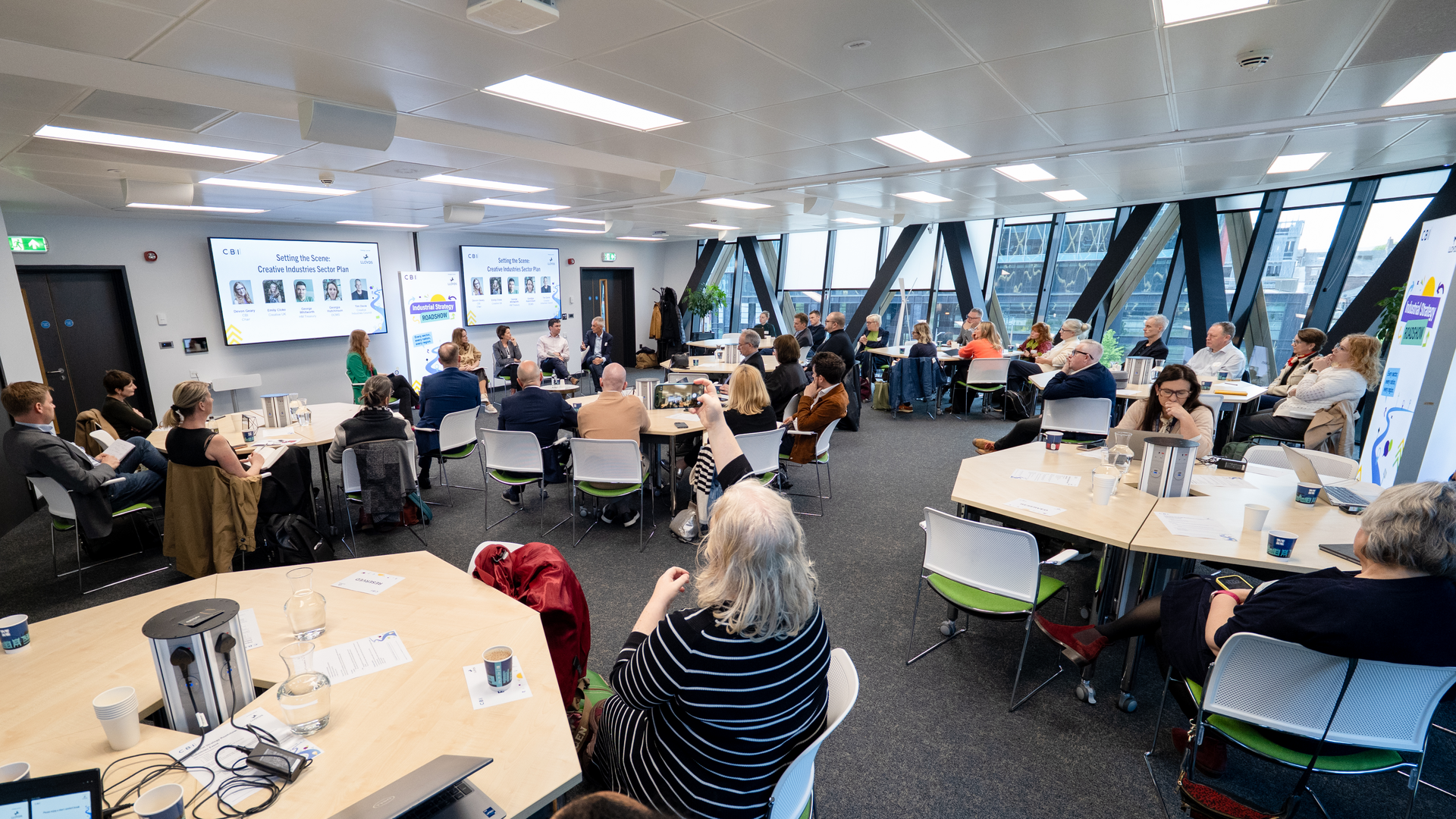
Looking back: Key insights from industry leaders
The Roadshow ran from 16 July 2025 – 8 July 2026 and drew on deep member insights, as well as the CBI’s engagement with government. This included our response to the Invest 2035 consultation, our membership on the Industrial Strategy Engagement Forum, our presentation of evidence to the Business and Trade Select Committee, and our Blueprint for UK Competitiveness.
You can read a summary of each event, including the key industry insights shared with government, below.
Shaping the Future: Strategic Insights on Government Spending
16 July 2025 | Birmingham
The Industrial Strategy Roadshow launched in Birmingham with a strong focus on the role of government spending decisions in underpinning long-term, sustainable growth across the UK. The event brought together business leaders, policymakers, universities, skills providers and regional stakeholders to explore how the Modern Industrial Strategy can move from ambition to delivery.
The discussion struck a pragmatic but constructive tone. There was broad support for the renewed emphasis on industrial policy and long-term planning, alongside a clear message that investment will ultimately be driven by confidence, policy stability and credible delivery. Speakers consistently underscored the need for closer partnership between government, industry and education to help firms respond to rapid technological change and evolving workforce demands.
Place-based growth was a central theme throughout. Participants emphasised that effective delivery must build on regional strengths, supporting both high-growth sectors and foundational industries. Skills, productivity and AI readiness also featured prominently, with a clear warning that organisations failing to embrace digital transformation risk falling behind in the race for talent and investment.
Birmingham set the direction for the wider Roadshow programme: creating a structured dialogue between business and government and ensuring that practical industry insight informs implementation. The overarching message was clear, unlocking growth will require long-term certainty, sustained collaboration and a shared commitment to delivery.
Key takeaways:
Delivering growth will depend on long-term collaboration between government, business and education.
Skills and productivity must keep pace with digital and AI-led transformation.
Place-based delivery must be central to a credible Industrial Strategy.
Businesses are looking for consistency, stability and long-term policy certainty to unlock investment.
Digital and Technology Roundtable
20 November 2025 | Reading
The Digital and Technology Roundtable in Reading brought together technology firms, policymakers, financial institutions and business leaders to examine how the UK can strengthen its position as a global technology economy. Hosted as part of the Industrial Strategy Roadshow, the discussion focused heavily on AI, innovation investment and digital adoption across sectors.
AI dominated much of the conversation, with businesses highlighting both the opportunities and risks associated with rapid technological change. Delegates discussed how trust, governance and regulation must evolve alongside innovation if businesses and consumers are to embrace AI adoption at scale. There was also strong focus on how government and industry can work together to ensure investment in emerging technologies delivers tangible benefits for businesses, communities and the wider economy.
Workforce readiness emerged as another key theme. Participants stressed that the challenge extends beyond technical specialists, arguing that broad AI literacy across the workforce will be critical to future productivity and competitiveness. Businesses also raised concerns around fragmented funding structures, uneven innovation support and the need for clearer long-term coordination across government.
Throughout the event, speakers reflected on the importance of moving beyond policy ambition and towards delivery. Delegates welcomed the opportunity to directly shape conversations around the Digital and Technologies Sector Plan while reinforcing the need for sustained collaboration between business and government.
Key Takeaways
AI remains central to business and government discussions.
Responsible innovation and public trust are essential to AI adoption.
Wider AI literacy will be critical to future productivity growth.
Businesses called for stronger coordination around innovation investment.
Defence and Advanced Manufacturing
15 January 2026 | Bristol
The Defence Roadshow event in Bristol explored how investment in defence and advanced manufacturing can support wider economic growth, resilience and regional capability across the UK. Bringing together business leaders, government representatives, academia and financial institutions, the discussion examined the growing role of defence within the UK economy and the Modern Industrial Strategy.
Delegates reflected on the need for increasing political clarity and momentum behind the Defence Industrial Strategy, alongside the opportunities this creates for businesses operating across the defence ecosystem, advanced manufacturing, supply chain and emerging technologies. A recurring theme was the need for a fundamentally more collaborative relationship between government and industry, particularly when supporting SMEs, regional manufacturers and innovation-driven firms.
Skills shortages were identified as one of the sector’s most pressing challenges. Businesses highlighted growing demand for specialist technical capability across engineering, cyber and advanced manufacturing, while warning that workforce shortages risk limiting future investment and delivery. Participants also emphasised the importance of clearer long-term demand signals, arguing that businesses require greater visibility to invest confidently in skills, facilities and sovereign capability.
The conversation repeatedly returned to the idea that defence should be viewed not only as a security priority but also as a strategic economic investment. Delegates highlighted the potential for defence-led innovation and dual-use technologies to generate wider benefits across the broader UK economy.
Key Takeaways
Defence is increasingly viewed as both a security and economic priority.
Skills shortages remain a major constraint on growth and delivery.
Businesses called for clearer long-term demand signals from government.
Greater collaboration between industry, finance and government is essential.
Life Sciences and the UK Growth Agenda
19 January 2026 | Cambridge
Business leaders, investors and policymakers gathered in Cambridge to discuss the future of the UK life sciences sector and its role within the Modern Industrial Strategy. The event focused on how the UK can strengthen its global competitiveness while accelerating investment, innovation and commercialisation across health and life sciences.
Businesses across the UK highlighted that, while the sector benefits from strong foundations- such as world-leading universities, cutting-edge research institutions, robust investor appetite, and advanced health data capabilities- it must do more to confidently promote its life sciences strengths on the international stage, while ensuring that innovative companies can successfully scale within the domestic market.
A recurring theme throughout the discussion was delivery. Businesses welcomed the broader ambition of the Industrial Strategy but stressed that credibility will depend on practical implementation over the next 6–12 months. Faster clinical trials, predictable regulatory pathways and quicker adoption of innovation were all identified as essential to maintaining momentum.
Throughout the session, the importance of regional ecosystems, collaboration, and long-term investment emerged as critical to the sector’s success. There was strong consensus that growth in life sciences will depend on coordinated action across government, the NHS, universities, regional leaders, and industry. Delegates also emphasised that the sector’s impact extends well beyond healthcare, with significant implications for productivity, exports, and economic growth across the wider economy.
Key Takeaways
The UK’s life sciences ecosystem remains globally competitive.
Businesses called for faster delivery and regulatory clarity.
Regional ecosystems and collaboration are critical to long-term growth.
Innovation adoption and commercialisation remain key priorities.
Mayoral Summit: Regional Growth and Investment
4 February 2026 | Manchester
Mayors, business leaders and universities came together in Manchester for a roundtable focused on how regional leadership can help drive growth and unlock the UK’s economic potential. The discussion highlighted a strong shared ambition to work in partnership, move at pace and turn regional potential into tangible economic outcomes.
A central theme was the need for investable regional pipelines that can attract UK and global capital. Participants emphasised that greater visibility on planning, delivery partners and policy stability is critical to accelerating investment, anchoring supply chains and strengthening the international competitiveness of UK regions.
Delegates also underlined the importance of strong collaboration between mayoral authorities and industry, creating a clearer front door for business and a more joined-up offer for investors. There was also recognition that more knowledge sharing is needed on pensions, patient capital and the practical barriers that can limit investment in infrastructure and regional priorities.
Universities were identified as central to regional talent, innovation and R&D, with their contribution strongest when aligned with business and civic priorities.
Local Growth Plans will also be important in linking regional strengths and devolved action to the Government’s Industrial Strategy, helping align local priorities with the national growth sectors and wider delivery goals.
Overall, the discussion reinforced that place-based growth will depend on closer collaboration across sectors and a continued focus on delivery through regional partnerships.
Key Takeaways
Regional investment pipelines require greater visibility and certainty.
Mayoral collaboration can strengthen the UK’s investment offer.
Universities remain central to regional innovation and talent development.
Place-based growth is essential to Industrial Strategy delivery.
Clean Energy Industries and the Transition Economy
12 February 2026 | Cardiff
The Clean Energy Industries Roadshow event in Cardiff brought together businesses, policymakers and investors to discuss how the UK can strengthen its position as a global leader in clean energy and industrial decarbonisation. Conversations focused on how long-term policy clarity, infrastructure investment and private capital can accelerate growth across the clean energy economy while supporting wider economic resilience and energy security.
Delegates reflected on the scale of opportunity emerging across the country, but particularly in Wales, for renewable energy, hydrogen, carbon capture and nuclear technologies. Participants welcomed the increasing alignment between the Clean Energy Industries Sector Plan and wider government focuses on regulatory and planning reform.
At the same time, businesses highlighted the importance of maintaining momentum in this sector by increasing the pace of delivery and implementation. Skills shortages, planning complexity and supply chain capacity were all identified as constraints on future growth. Delegates also discussed the importance of regional industrial strengths, with Wales and other clean energy clusters viewed as critical to delivering long-term economic transformation.
Throughout the discussion, there was strong optimism about the UK’s clean energy future, alongside recognition that sustained collaboration between business, government and investors will be essential to turning ambition into large-scale delivery.
Key Takeaways
The UK continues to strengthen its position as a clean energy leader.
Long-term policy certainty is critical to unlocking private investment.
Skills and supply chain capacity remain key delivery challenges.
Regional clean energy clusters are central to future growth.
Industrial Strategy in Northern Ireland
25 February 2026 | Belfast
The Industrial Strategy Roadshow arrived in Belfast for a discussion focused on Northern Ireland’s role within the UK’s wider growth agenda. Business leaders, policymakers and regional stakeholders explored how industrial strategy can support investment, innovation and productivity growth across Northern Ireland while strengthening connections with wider UK economic priorities.
Discussions focused on the region’s existing strengths across advanced manufacturing, technology, life sciences and professional services, alongside the opportunities created by Northern Ireland’s unique trading position. Delegates highlighted the importance of policy coordination between Westminster, Stormont and local institutions to ensure businesses can fully capitalise on investment opportunities.
The challenges that Northern Ireland face were also discussed and that it remains an expensive place to manufacture and do business. Businesses face a cumulative burden of rising costs and these pressures compound, directly affecting not only global competitiveness but also Northern Ireland’s ability to compete with GB competitors.
Skills, connectivity and business confidence emerged as major themes throughout the event. Participants stressed the need for stronger infrastructure links, workforce development and greater visibility around long-term industrial priorities. There was also significant discussion around how Northern Ireland can strengthen its international competitiveness while continuing to attract investment into regional innovation clusters.
The event reinforced the Roadshow’s broader emphasis on place-based growth and regional engagement. Northern Ireland businesses remain resilient and ambitious. The consistent message was not one of pessimism, but of urgency: the opportunity is real, and there is a clear cost to failing to support industry in realising its full potential, particularly when geopolitical uncertainty is elevated.
Key Takeaways
Northern Ireland’s industrial strengths present significant growth opportunities.
Policy coordination across governments and institutions remains essential.
Skills, infrastructure and connectivity continue to shape competitiveness.
Regional business engagement must remain central to Industrial Strategy delivery.
There is an urgent need to ensure parity with Great Britain in accessing industry support schemes.
Financial Services and Economic Growth
5 March 2026 | Edinburgh
Business leaders, policymakers and financial institutions gathered in Edinburgh to examine the role of financial services within the UK’s Modern Industrial Strategy. The discussion focused on how the sector can support investment, innovation and growth across the wider economy while maintaining the UK’s international competitiveness.
Firms reflected on the importance of long-term stability, proportionate regulation and investment confidence in supporting future growth. Participants also explored how financial institutions can help accelerate innovation, support regional investment and strengthen access to capital for businesses across priority growth sectors.
Technology and digital transformation featured heavily throughout the discussion, particularly around AI adoption, cyber resilience and the future of financial innovation. Businesses highlighted both the opportunities and implementation challenges associated with digital transformation, while stressing the importance of workforce readiness and skills development.
The conversation also examined the role financial services can play in supporting wider Industrial Strategy objectives, including infrastructure investment, regional growth and business scaling. Delegates agreed that stronger collaboration and strategic alignment between government, regulators and industry will be essential to ensuring the sector continues to act as a catalyst for investment and long-term economic growth across the UK.
Key Takeaways
Financial services remain central to investment and economic growth.
Businesses called for stable and proportionate regulatory frameworks.
AI and digital transformation continue to reshape the sector.
Financial institutions play a critical role in supporting wider Industrial Strategy delivery.
Professional and Business Services
6 May 2026 | London
The Professional and Business Services Roadshow in London underscored the sector’s critical role in driving investment, productivity and competitiveness across the wider UK economy. Bringing together businesses, policymakers and industry leaders, the discussion focused on how the sector can help deliver the ambitions of the Modern Industrial Strategy.
A clear priority for businesses was the need to accelerate digital adoption, including AI integration and strengthened cyber resilience. While the opportunities are significant, firms highlighted persistent barriers, particularly for SMEs, in adopting new technologies at pace. There was a strong call for more practical, accessible support, alongside flexible skills provision and more effective regional delivery mechanisms to ensure businesses across the country can fully realise the benefits of technological change.
The discussion also reinforced the sector’s broader economic value. Professional and Business Services underpin performance across multiple industries, supporting exports, unlocking investment and driving productivity gains. Participants emphasised that policy interventions in this sector have a multiplier effect, delivering wider spillover benefits across the economy.
Throughout the session, businesses stressed the importance of stable policy frameworks, proportionate regulation and better alignment between regional growth strategies and workforce development. The opportunity for direct engagement with government was widely welcomed, alongside a shared recognition that sustained partnership will be essential as the Industrial Strategy moves from design to delivery.
Key takeaways:
Professional and Business Services are a key enabler of productivity and growth across the wider economy.
AI, digital adoption and cyber resilience present significant opportunities, but require targeted support, particularly for SMEs.
Closer alignment between skills reform and regional growth strategies is critical to delivery.
Businesses are seeking stability, proportionate regulation and practical support to translate strategy into outcomes.
Creative Industries and Regional Innovation
14 May 2026 | Newcastle
The final stop of the Industrial Strategy Roadshow in Newcastle highlighted the central role of the UK’s Creative Industries in driving regional growth, exports and innovation. Bringing together creative businesses, policymakers, universities and cultural organisations, the discussion focused on how the sector can sustain growth while navigating ongoing financial pressures and rapid technological change.
A consistent theme was the tension between strong national ambition and the underlying fragility of many firms operating in challenging economic conditions. Participants emphasised the need to unlock investment and strengthen regional ecosystems, ensuring growth is not confined to established hubs but distributed more evenly across the UK. Cluster development, underpinned by local partnerships, was identified as critical to achieving this.
Technology and innovation were at the forefront of the discussion, particularly the growing importance of CreaTech, digital tools and international markets. Businesses highlighted both the opportunities and risks associated with rapid technological change, alongside the need to build resilience against geopolitical and economic shocks while maintaining the UK’s global competitiveness and export strength.
The event reinforced the importance of place-based delivery, with regional clusters, universities and local leadership seen as key enablers of the sector’s success. Delegates also welcomed the opportunity to engage directly with policymakers, ensuring that business insight informs the development of the Creative Industries Sector Plan.
Key takeaways:
Creative clusters are critical to unlocking regional growth and levelling up opportunity across the UK.
Financial fragility remains a challenge for many businesses within the sector.
Technology, CreaTech and digital innovation are reshaping the sector’s growth trajectory.
Strengthening export support and investment pathways will be key to sustaining competitiveness.
Rain Newton-Smith
Chief Executive, CBI
"In the UK, we have the makings of a true growth story: all the ideas, talent and ambition we need. But to turn that into a reality, we need the Government to create the conditions for investment: from skills and infrastructure to innovation and regulation. Above all, what business needs now is for Government to deliver and give business the confidence to get moving. Fix the fundamentals, and businesses will do what they do best: invest, grow and drive the UK forward."

The Rt Hon Peter Kyle MP
Former Secretary of State for Business and Trade (5 September 2025 – 20 July 2026)
"The CBI-Lloyds roadshow has taken our Industrial Strategy out of Whitehall and into the real economy - working directly with businesses, listening to their priorities, and shaping delivery around what will drive growth on the ground as we push on into year two."

Amanda Murphy
CEO, Business & Commercial Banking, Lloyds
"Businesses across the UK want to invest and grow and the priority now is creating the right conditions to unlock that. Through the Industrial Strategy Roadshow, we’ve brought industry and government together to focus on what drives growth - increasing investment, accelerating innovation and strengthening skills in key sectors and regions. With more than £35 billion of finance available this year, we’re committed to backing businesses across the UK to scale and supporting long-term, sustainable growth."

A year in numbers
How we brought together industry and government


Sectors represented

Professional and business services

Advanced manufacturing

Public sector and government

Financial services

Defence

Universities

Clean energy industries

Digital and technologies

Life sciences

Foundational sectors

Creative industries
Delivered in partnership with: